Maritime Alert - November 2026
For more information, contact:


Themes

Maritime cabotage for humanitarian aid
Through Ministerial Resolution No. 649-2026-MTC/01.02 (the “Resolution”), the Ministry of Transport and Telecommunications (“MTC”) authorizes shipping, fishing, tourism and related companies to transport passengers, goods and humanitarian aid supplies between domestic ports during states of emergency. This authorization applies exclusively to vessels entered in a Temporary Register and requires coordination with the MTC and the National Port Authority (APN). It does not constitute a general liberalization of cabotage.
1. Content and scope of the Resolution
The Resolution, published on November 12, 2026, exceptionally and temporarily authorizes maritime cabotage for humanitarian purposes for the duration of a declaration of a state of emergency. The service may be provided at authorized ports and port terminals and may include the transportation of passengers, goods and supplies necessary to assist the affected population.
- Eligible entities: Shipping, fishing, tourism and related companies, provided they hold the applicable sector-specific authorizations.
- Procedure: Submission to the MTC’s Directorate of Waterborne Transport Authorizations of a list of vessels and the type of service to be provided, including cargo or passenger transportation, for registration in the Temporary Register of Vessels.
- Implementation and oversight: These are the responsibility of the MTC and the National Port Authority, within their respective areas of competence, without prejudice to the powers of the Maritime Authority regarding navigational safety, certificates and vessel fitness.
- Substantive and temporal limitations: Operations must serve humanitarian aid purposes and are limited to the duration of the relevant state of emergency.
2. Comparación normativa
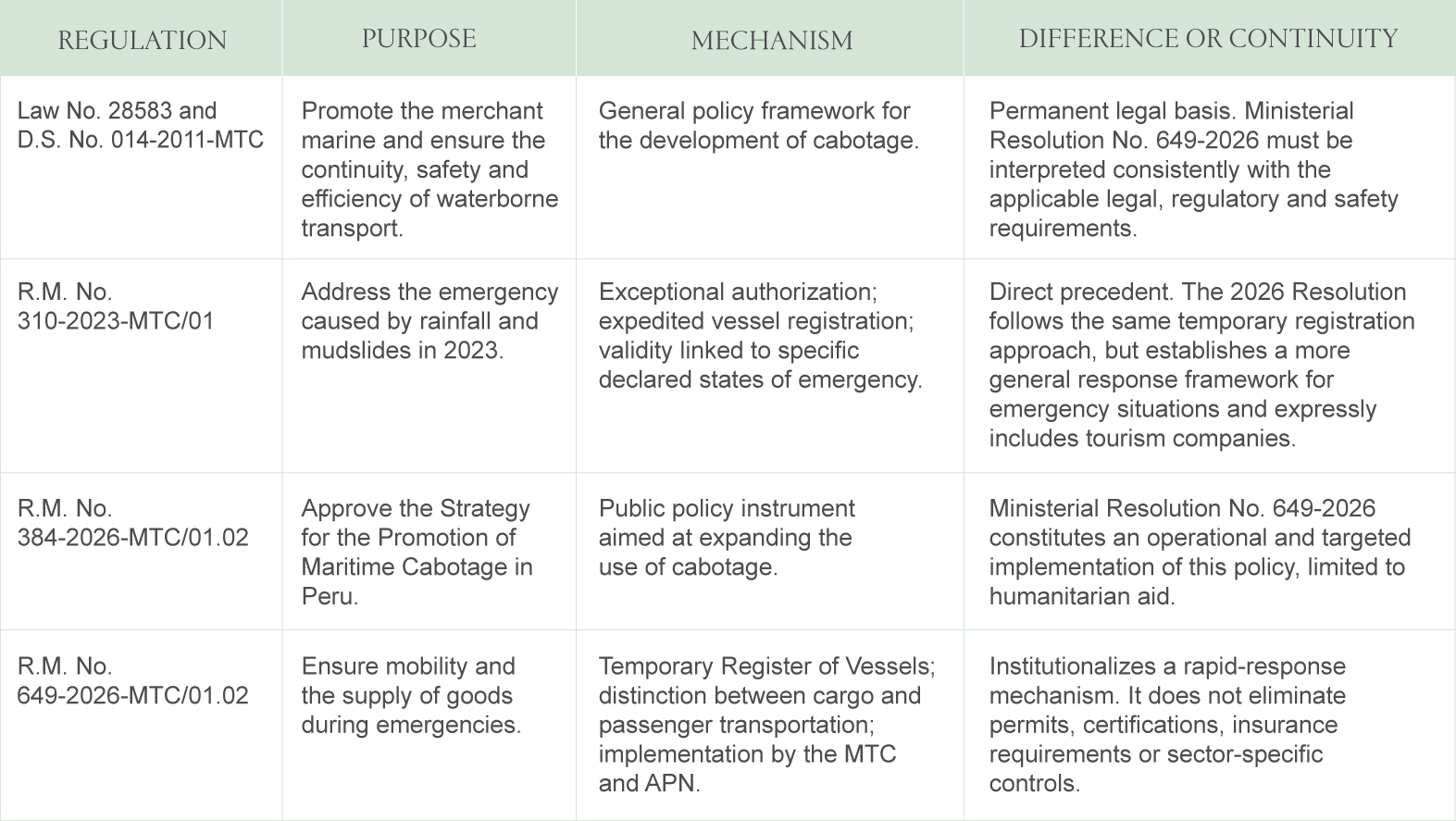
3. Key legal and operational implications
a) For operators and shipowners: Temporary registration should not be construed as a waiver of requirements relating to seaworthiness, manning, certification, vessel registration, trading authorizations, port security or the specific fitness of a vessel to carry passengers or certain types of cargo. Fishing or tourist vessels intending to deviate from their ordinary operational profile must verify that their certificates and operational limitations cover the proposed service.
b) For port terminals and authorities: Implementation will require prompt coordination among the MTC, APN, DICAPI, port operators and the entities responsible for managing the emergency. It would be advisable to establish protocols addressing berthing priorities, the receipt and custody of goods, manifests, passenger control, dangerous goods, tariffs and delivery traceability.
c) For insurers and P&I Clubs: Before commencing operations, it is necessary to review whether the humanitarian use changes the declared use of the vessel, trading area, type of cargo, number of passengers or operating conditions contemplated under hull and machinery, P&I, personal accident, carrier's liability and cargo insurance policies. Written confirmation of coverage should be obtained, and any material change in the risk should be notified.
d) Contractual liability: The humanitarian purpose does not automatically exclude liability for loss, damage, delay, injury or death. The contract of carriage, delivery and receipt records, reservations, applicable liability limits and contractual allocation of risks among the State, operator, terminal and cargo owner should be duly documented.
4. Immediate recommendations
a) Prepare a regulatory dossier for each vessel, including certificates, classification, insurance, crew details, capacity and authorization to carry cargo or passengers.
b) Request confirmation from the MTC that the vessel has been registered in the Temporary Register before committing to schedules or accepting cargo or passengers.
c) Obtain express confirmation from the insurer and P&I Club that coverage extends to the humanitarian service and its intended routes.
d) Agree in writing with the requesting entity on the allocation of responsibilities, indemnities, documentation, costs, custody arrangements and handover procedures.
e) Implement a voyage-by-voyage compliance control system, including manifests, capacity limits, weather conditions and proof of delivery.
5. Conclusion
The Resolution strengthens the State’s logistical response capacity and consolidates cabotage as an alternative when roadways are disrupted. Its practical usefulness will nevertheless depend on the coordination of temporary registration with maritime and port authorizations, safety requirements and insurance coverage. The main precaution for operators is to ensure that the humanitarian urgency is not construed as an exemption from technical obligations or liability.