Entry into force of the High Seas Treaty and its implications for the insurance sector
Professional participants

Themes
Entry into Force of the High Seas Treaty
The Agreement on the Conservation and Sustainable Use of Marine Biological Diversity of Areas Beyond National Jurisdiction (BBNJ), also known as the High Seas Treaty, entered into force internationally on January 17, 2026. This follows the achievement of the minimum number of ratifications required by the treaty itself, in accordance with the procedures established by the United Nations.
As of that date, the BBNJ Agreement became a legally binding instrument for the States that have ratified it, establishing new rules for the environmental governance of the high seas. Its entry into force marks a milestone in international maritime law, introducing for the first time a global regime specifically aimed at protecting marine biodiversity beyond national jurisdictions.
For States that have only signed it—as is the case with Peru—the treaty does not yet create domestic legal obligations. However, it does establish a new international standard that will progressively impact the regulation, oversight, and risk allocation associated with maritime and offshore activities.
What is the BBNJ Agreement (High Seas Treaty)?
The BBNJ Agreement is a multilateral treaty adopted within the framework of the United Nations in June 2023. Its primary objective is to ensure the conservation and sustainable use of marine biodiversity on the high seas—areas that represent approximately two-thirds of the planet's ocean surface.
The treaty is structured around four fundamental pillars:
- Marine genetic resources, including the fair and equitable sharing of benefits arising from their utilization.
- Area-based management tools, such as marine protected areas on the high seas.
- Environmental impact assessments for activities with potential significant adverse effects.
- Capacity-building and the transfer of marine technology, especially in favor of developing countries.
Unlike other traditional instruments of maritime law, the BBNJ does not focus on the safety of navigation or the prevention of ship-source pollution; instead, it centers on the systemic protection of marine ecosystems in areas beyond any state jurisdiction.
Comparison of BBNJ with SOLAS and MARPOL
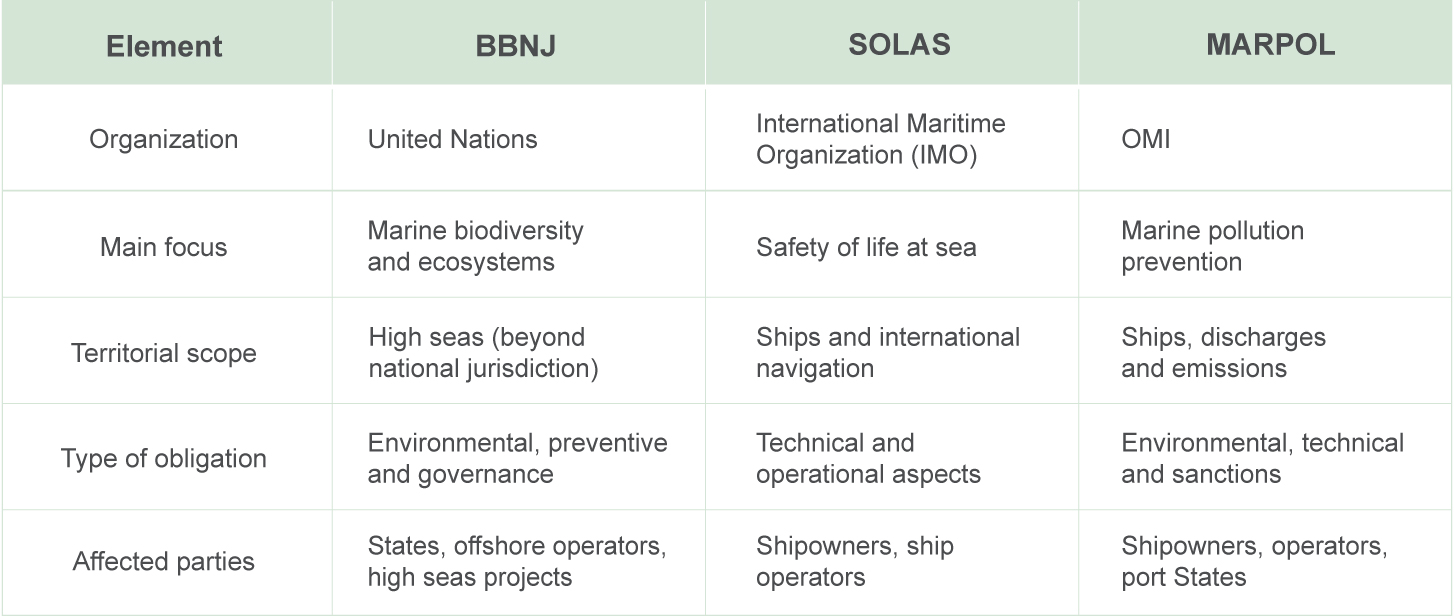
While SOLAS primarily addresses the safety of ships, crews, and passengers, and MARPOL regulates pollution originating from vessels, the BBNJ expands the focus to human activities on the high seas, including offshore operations, energy exploration, scientific research, and potential cumulative impacts on the marine environment.
In practical terms, the BBNJ does not replace or contradict SOLAS or MARPOL; rather, it complements them by integrating a new level of ecosystem-oriented environmental obligations that go beyond the vessel as the regulated unit.
Repercussions for the Insurance Sector
The entry into force of the BBNJ has significant implications for the insurance and reinsurance sectors, particularly regarding:
- Increase in environmental regulatory risk, especially for high-seas operations subject to more stringent environmental impact assessments (EIAs).
- Review of environmental liability, P&I, and offshore policies, in anticipation of potential claims linked to damages to marine biodiversity.
- Greater potential exposure to administrative sanctions and transboundary claims, for which liability could extend to operators, contractors, and indirect insured parties.
- Need to adjust underwriting criteria, pricing, and exclusions for energy and maritime activities with a relevant environmental footprint.
The treaty consolidates a trend toward the internalization of environmental risk, which is expected to manifest in higher compliance requirements and preventative risk management for insured parties.
Final Consideration
Peru has signed (but not yet ratified) the BBNJ Agreement—or High Seas Treaty—as a non-party State to the 1982 United Nations Convention on the Law of the Sea (UNCLOS). Consequently, this does not alter its legal position nor imply the assumption of any obligations regarding said Convention. The Peruvian State maintains sovereignty and jurisdiction over its maritime domain of 200 miles adjacent to its coasts, in accordance with the provisions of the 1993 Political Constitution of Peru.