Insurance and Reinsurance Alert - September 2026
For more information, contact:


Themes

Resolution SBS No. 02260-2026: New Regulation on Parametric Insurance
The Superintendency of Banking, Insurance and Private Pension Fund Administrators (SBS) has approved Peru’s first Regulation on Parametric Insurance. The new regulation establishes the conditions for designing, marketing, and managing this type of insurance, under which payment is triggered when an objective parameter reaches or exceeds the threshold established in the policy, without the need to directly quantify the damage or loss suffered.
This insurance modality aims to expand protection alternatives against natural disasters and enable a faster response to large-scale events, without requiring a prior assessment of the actual damages incurred.
The Resolution entered into force on September 13, 2026, and also amends the Regulation on the Marketing of Insurance Products and the Internal Audit Regulation. Insurance companies have 180 calendar days from its effective date to adapt any previously registered parametric insurance policy models, where applicable.
What characterizes parametric insurance?
- Objective trigger: Payment depends on the magnitude or intensity of a natural phenomenon, measured through an independent and verifiable parameter, reaching or exceeding the agreed threshold.
- Non-indemnity payment: The insured amount is determined according to the structure set out in the policy and does not depend on the direct quantification of the actual loss suffered.
- Limited coverage: It only covers risks arising from natural phenomena, including meteorological, climatological, geological, geophysical, oceanographic, or other events that cause environmental impacts.
- No financial participation by the insured: No deductibles, franchises, co-insurance arrangements, or copayments may be applied to reduce the payment of the insured amount.
Key Provisions
- Insurable interest: An insurable interest must exist and be verified by the insurer before the policy is issued. The cost of this verification may not be passed on to the policyholder or insured through charges additional to the premium.
- Independent data sources: The policy must identify both a primary and a secondary data provider, each independent from the insurer and recognized for their technical expertise. The secondary source may only be used when the primary source is unable to publish the required information.
- Calculation agent: This function may be performed by an internal unit of the insurer or by a third party. The calculation agent must monitor the parameter, verify whether the threshold has been reached, and calculate the corresponding payment. Even when this function is outsourced, the insurer remains responsible to the customer.
- Enhanced minimum content requirements: The policy must specify, among other elements, the insured event, parameter, threshold, geographic area, payment structure, data providers, calculation agent, applicable deadlines, and dispute resolution mechanisms.
- No hybrid products: Parametric coverages may not be incorporated as part of the coverages under a traditional insurance policy.
Trigger and Payment: Short Deadlines
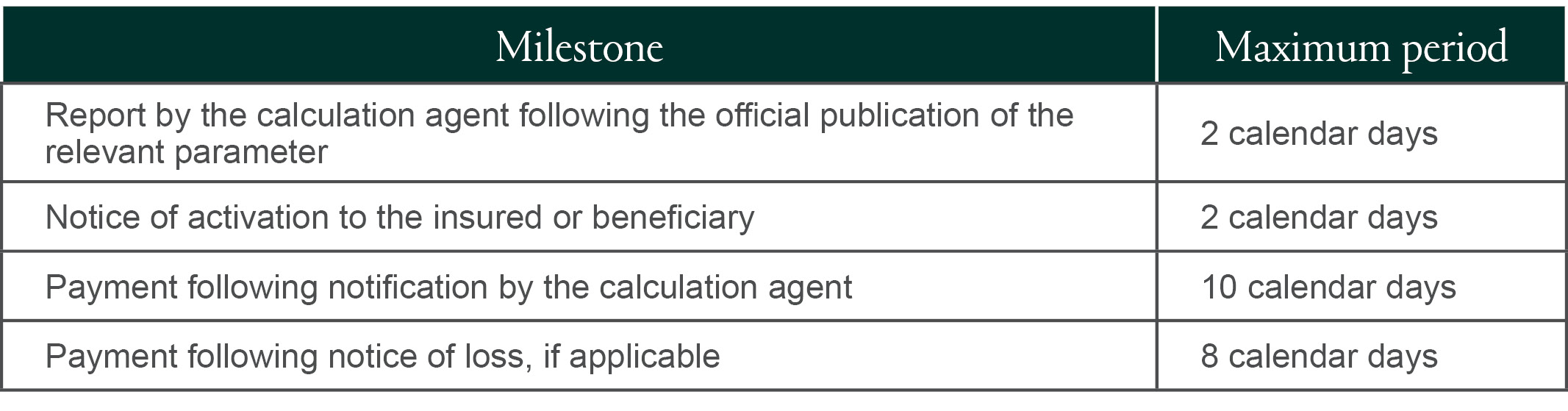
The insured or beneficiary is not required to report a claim. Instead, the insurer must monitor the agreed parameter and notify the insured when coverage is triggered because the applicable threshold has been reached or exceeded.
The Main Point of Attention: Basis Risk
The regulation requires the express disclosure of the possibility that a discrepancy may exist between the actual loss suffered and the payment received. It may even occur that the insured suffers a loss, but coverage is not triggered because the parameter did not reach the agreed threshold. This risk must be disclosed in the policy, supported through simulations and historical correlation analyses in the technical note, and explained with examples in the product guide.
Distribution, Reinsurance and Supervision
- Distribution: Parametric insurance may be distributed directly by the insurer, through insurance brokers or, in the case of marketers, exclusively through bancassurance arrangements. Personnel involved in the distribution of these products must receive specific training on the operation of the product, basis risk and the payment mechanism.
- Reinsurance: Reinsurance agreements must maintain terms and conditions that are substantially consistent with those of the underlying policy and must not contain material mismatches that would prevent the recognition of effective risk transfer for regulatory purposes.
- Reporting and Internal Audit: Insurers must submit Annex ES-37 to the SBS on a quarterly basis, within fifteen (15) calendar days following the end of each calendar quarter.
What Should Companies Review?
- Product inventory: Identify existing policies that may qualify as parametric insurance policies.
- Policy and technical documentation: Align the policy wording, technical note, and product guide, particularly with respect to the parameter, threshold, basis risk, and payment structure.
- Reinsurance program: Verify that there are no material mismatches between the direct coverage and the corresponding reinsurance agreement