Labor Newsletter - October 2026
Themes

LABOR NEWS
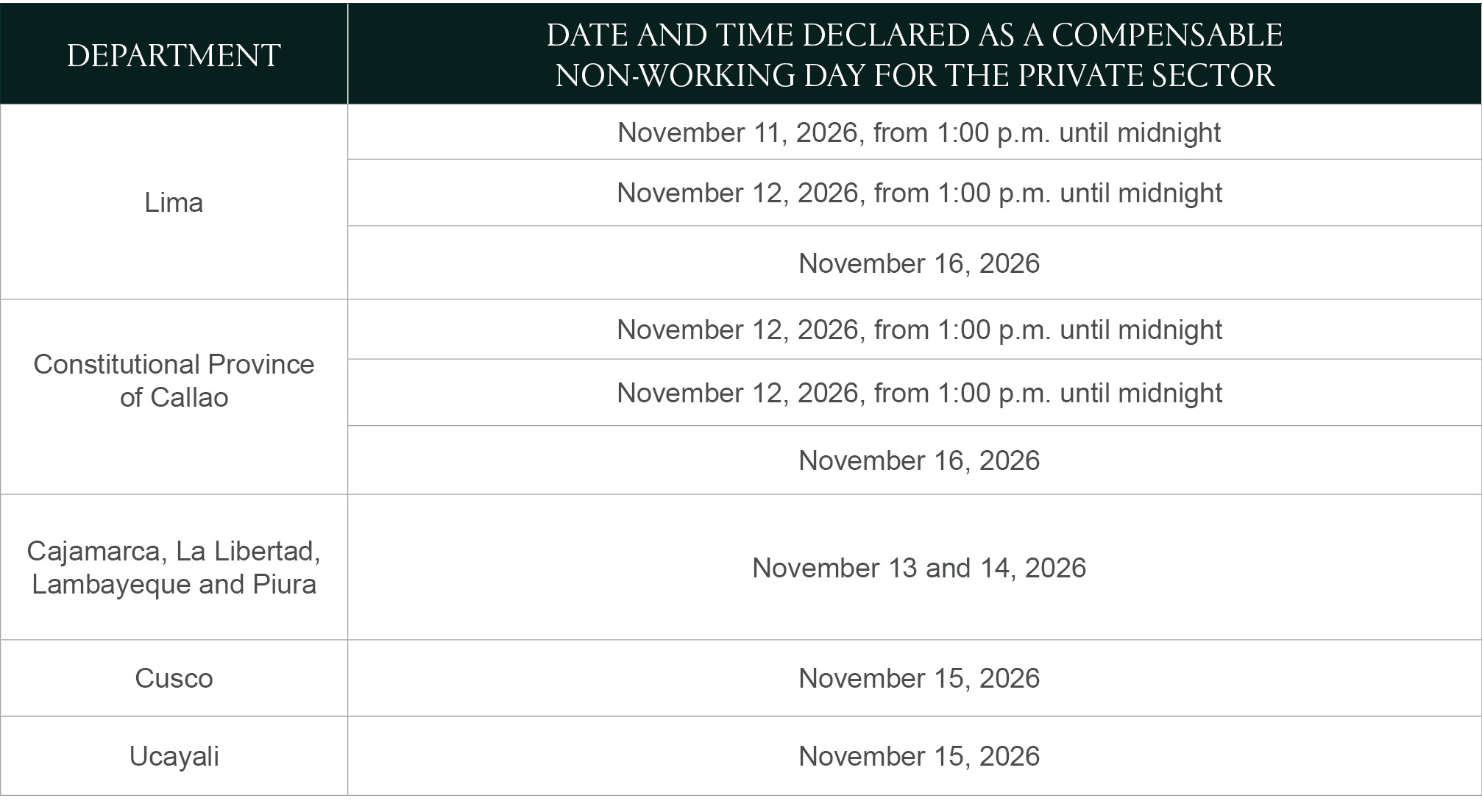
Compensable non-working days declared for the visit of Pope Leo XIV
Supreme Decree No. 020-2026-TR declared compensable non-working days from November 11 to 15. This measure is mandatory for the public sector and optional for the private sector.
Private-sector workplaces may adopt this measure subject to a prior agreement between the employer and employees, including the arrangements for making up the hours not worked. In the absence of an agreement, the employer shall decide.
The compensable non-working days in question are as follows:
INSPECTIONS
Criteria established for determining the validity of fixed-term employment contracts entered into for the commencement or increase of business activities
Through Resolution No. 1130-2026-SUNAFIL/TFL-First Chamber, the Labour Inspection Tribunal (TFL) of SUNAFIL set aside the penalty imposed on a company for violating the provisions governing fixed-term employment contracts.
The contracts had been entered into on the grounds of an increase in business activities. The objective grounds relied upon were the launch of new products, the relaunch of existing products, and the expansion of distribution channels. The labour inspection authority did not dispute the existence of these circumstances. However, it considered that the contracts had been mischaracterized because the company had failed to demonstrate that its permanent staff was unable to meet the increased production requirements. It also noted that the company had not provided data on production levels, forecasts, or the number of employees required.
The TFL disagreed with this reasoning and established the following criteria:
- The work may be related to the company’s main business activities: this type of contract covers both the commencement of a new activity and an increase in existing activities. Accordingly, there is no legal impediment to the work being related to the company’s main business activities, provided that it responds to the temporary increase that constitutes the objective grounds for hiring.
- The ordinary nature of the work is not, in itself, sufficient to conclude that the employment contract has been mischaracterized. The assessment must address two issues:
- whether the objective grounds sufficiently identify and explain the business circumstances that gave rise to the temporary hiring; and
- whether there is a basis for concluding that such grounds concealed a permanent staffing need.
- Scope of the precedent established by Plenary Chamber Resolution No. 015-2023-SUNAFIL/TFL: the circumstances justifying temporary hiring must be sufficiently and adequately stated and explained in the original employment contract. However, the precedent does not require the relevant clause to specify growth percentages, historical production levels, exact numbers of additional employees, manufacturing dates, or a mathematical comparison between the capacity of permanent staff and projected production. Such elements may serve as useful evidence, but they are not independent formal requirements under Articles 57 and 72 of the Consolidated Text of the Labor Productivity and Competitiveness Law (TUO of the LPCL).
- The mere mention of new products is not sufficient in every case: the specific content of the clauses and the documentation submitted must be assessed. On that basis, it must be determined whether the objective cause is genuine and, if so, whether it corresponded to a permanent need for labor.
Consequently, the TFL concluded that a permanent need for labor had not been established. It further noted that requiring quantitative indicators as an independent requirement for validity does not follow from the law or from the binding precedent.
OCCUPATIONAL SAFETY AND HEALTH
Approval of the List of Principal and Related Activities to Which the Occupational Health and Safety Regulation for the Construction Sector Applies
Through Ministerial Resolution No. 310-2026-TR, the Labor Authority approved the list of construction activities and related activities to which the sector-specific occupational safety and health regulations apply.
Construction activities include those covered by Divisions 41, 42, and 43 of Section F of Revision 4 of the International Standard Industrial Classification (ISIC), such as the construction of buildings, including prefabricated buildings made of various materials; the construction of roads and railways; the construction of public utility projects; civil engineering works; demolition; site preparation; electrical installations; among others.
Related activities include catering, camp management, and security services; medical services; surveying services during the construction process; and other activities carried out as part of the construction process.
This regulation repeals Ministerial Resolution No. 251-2021-TR, which established the previous list of activities.
The list will be reviewed every three years or whenever circumstances so warrant.
MONTHLY REMINDER
Payment of Compensation for Length of Service (CTS) for the May–October 2026 period
Employers must make the payment by Monday, November 16, 2026, as November 15 is a non-business day.