Tax Newsletter - December 2025
Themes

REGULATIONS OF INTEREST
1. Delegation of powers
Law No. 32527, published on December 15, 2025, delegates to the Executive Branch the power to legislate on tax and customs matters for a period of 60 calendar days from December 16, 2025. (This period expires on February 16, 2026). The Executive Branch may legislate on the following matters:
- IGV Collection Regime: The aim is to incorporate and specify exceptional cases for the application of the 10% collection on the importation of goods, based on the level of risk and the degree of tax and customs compliance of the importer. For these purposes, the first importation would be considered to be that originating from the same cargo manifest.
- Tax Liability Payment System (SPOT): The aim is to amend paragraph 9.3 of Article 9 of Legislative Decree 940, which regulates the Tax Liability Payment System, by incorporating the existence of “outstanding tax debt” as a reason for entering funds into the deduction account, provided that the debt is enforceable. This authorization does not modify the current legal framework applicable to micro and small enterprises, regulated by Law No. 31903.
2. Amendments related to Income Tax
The Income Tax Law Regulations (LIR) are amended.- Supreme Decree No. 302-2025-EF, published on December 17, 2025, amends various articles of the Income Tax Law Regulations in order to regulate the application of the “other methods” of transfer pricing provided for in paragraph 7) of subsection e) of Article 32-A of the Income Tax Law (i.e., discounted cash flow, multiples method, equity value method, appraisal, among others), establishing technical standards and documentary requirements.
Based on these provisions, the following applies:
- The aforementioned “other methods” have been in force since December 18, 2025.
- These methods may be applied, among others, to transactions involving the transfer of shares, trademarks, intangibles, and fixed assets.
- There is no hierarchy among the “other methods”; only the most appropriate one prevails.
- For the application of "other methods," best practices are considered, such as the International Valuation Standards (IVS) issued by the IVS Council. There are no specific guidelines in the Regulations.
- The taxpayer must have a Technical Report that contains, at a minimum, the information required by the IVS in force as of January 31, 2025.
Modification of accrual in payments on account for first category income.- Law No. 32541, published on December 31, 2025, amended the first paragraph of Article 84 of the Income Tax Law so that, as of January 1, 2026, taxpayers who obtain income from real estate rentals must pay the corresponding payment on account in the month in which such income is received.
The exception to the obligation to make payments on account of employment income is regulated.- Through Superintendency Resolution No. 390-2025/SUNAT, published on December 31, 2025:
- New amounts are established for the exception to the obligation to make payments on account and the suspension of the obligation to make withholdings and/or payments on account with respect to income tax on fourth and/or fifth category income for the 2026 fiscal year.
- The format for submitting the Request for Suspension of Withholdings and/or Payments on Account is approved and will be available on SUNAT Online Operations from January 1, 2026.
3. Amendments related to the Tax Code
In order to optimize SUNAT's auditing powers and adapt them to digital transformation, Legislative Decree No. 1523 was published on February 18, 2022, amending Articles 62, 87, and 177 of the Tax Code, establishing, among other things, that: i) SUNAT may request the appearance, either in person or remotely, of tax debtors or third parties to provide the information deemed necessary, and ii) taxpayers will be required to provide SUNAT with access profiles to the electronic processing system they use to record their accounting operations.
Under the scope of the aforementioned amendments to the Tax Code, on December 17, 2025, Supreme Decree No. 303-2025-EF was published, establishing the following implementation measures:
- Remote Appearance: In addition to physical appearances, SUNAT may summon taxpayers and third parties to appear via videoconference or other similar means, in the context of definitive or partial audits (other than partial electronic audits) and in inductive actions. The aforementioned Supreme Decree also regulates the formal requirements for the summons, documentation, holding, and communications of the remote appearance, as well as the procedure for rescheduling, situations to consider if connection problems arise, and the possibility of requesting a change to an in-person appearance only in justified cases, such as areas with low or no internet connection.
- Access Profiles: In order to comply with the obligation to provide access profiles to their electronic accounting operations processing system, taxpayers must provide SUNAT with access, either in person at their premises or remotely, by providing a username and password or other security mechanism. Taxpayers must ensure that this access allows SUNAT to: i) change the password or other security mechanism provided; ii) view the accounting operations for the periods under audit; and iii) generate and download reports. In addition, Supreme Decree No. 303-2025-EF has made amendments to SUNAT's Audit Regulations, approved by Supreme Decree No. 085-2007-EF, with the aim of adapting them to the delivery and use of these access profiles.
4. Modifications related to tax benefits
The tax benefit provided for in Law No. 30309, which promotes scientific research, technological development, and innovation (R&D&I), is clarified.- Law No. 32539, published on December 31, 2025, establishes that the tax benefit applicable to R&D&I expenses will be applicable to projects that begin in 2016 and remain in effect until December 31, 2028.
The application of the VAT exemption provided for in Law No. 32434 for the agricultural sector is regulated.- Superintendency Resolution No. 000391-2025/SUNAT, published on December 31, 2025, establishes the form, deadline, and conditions for submitting the application for the aforementioned VAT exemption.
- The applicant must be included as a beneficiary within the scope of Article 4 of the aforementioned Law and have their waiver of VAT exemption approved until December 31, 2025.
- The application is free-form and may be submitted through SUNAT's Virtual Reception Desk or at Taxpayer Service Centers from January 1 to April 1, 2026.
- SUNAT must respond to the application within a maximum of 45 business days. If there is no response, the application is deemed denied.
Exemptions under the VAT and ISC Law are extended.- Law No. 32542, published on December 31, 2025, in a Special Edition, has extended the validity of the exemptions contained in Appendices I and II of the VAT and ISC Law until December 31, 2028.
The ISC refund benefit provided for in Emergency Decree No. 012-2019 is extended to providers of public land transport services for freight and passengers.- Law No. 32540, published on December 31, 2025, in a Special Edition, extends the ISC refund benefit to providers of the aforementioned public land transport service until December 31, 2028.
5. Formal obligations before SUNAT
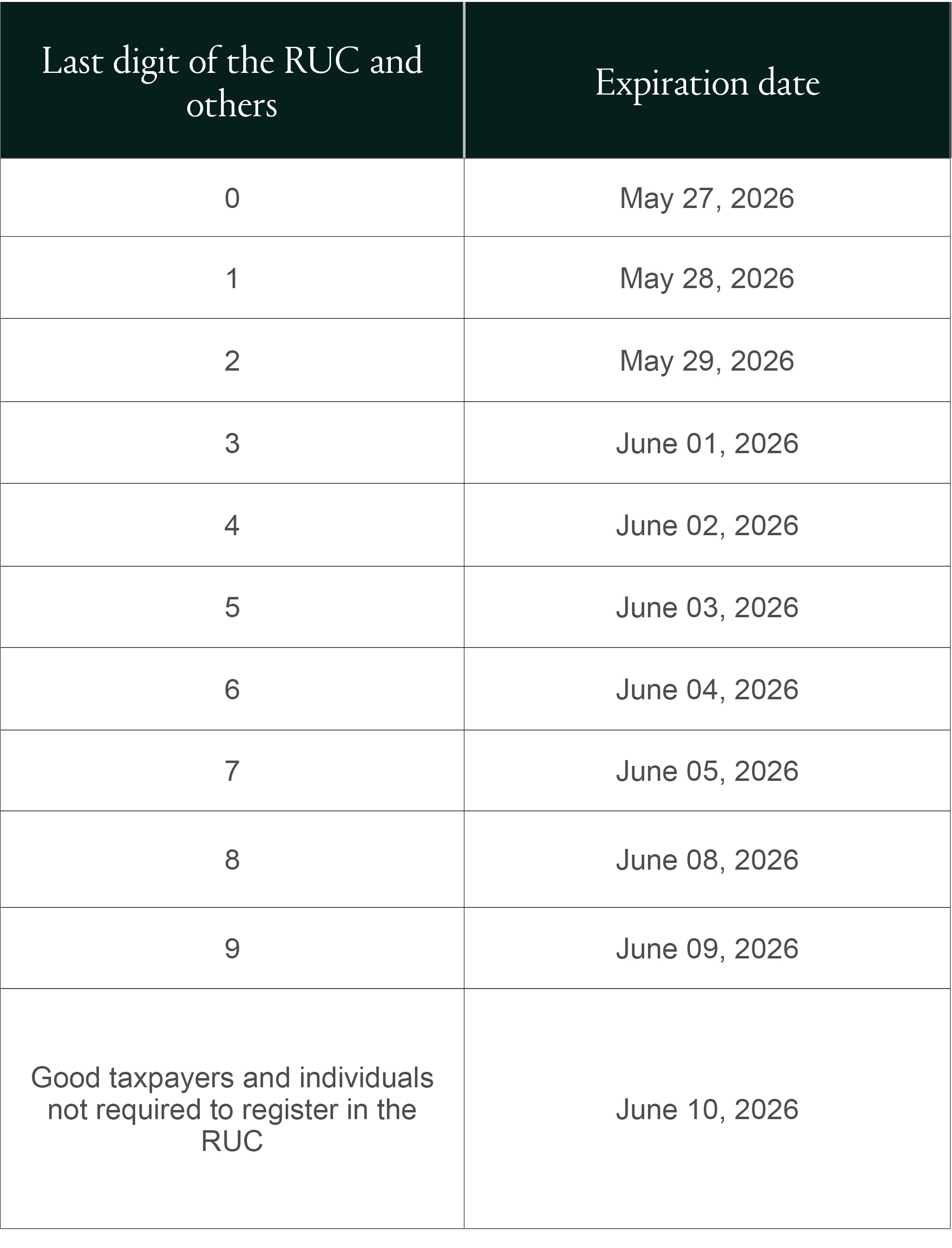
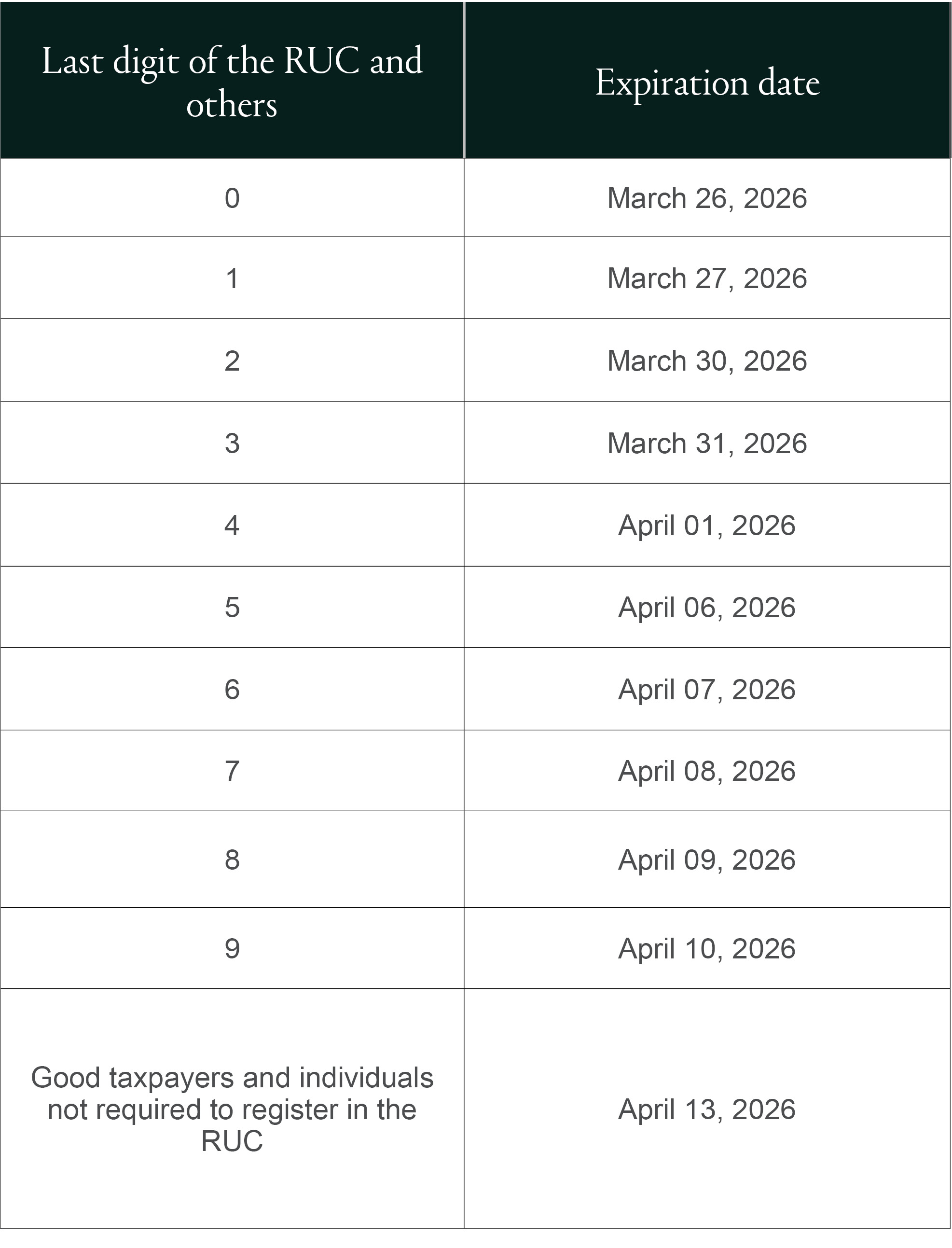
Provisions for the Annual Income Tax Return for the 2025 Tax Year.- Superintendency Resolution No. 386-2025/SUNAT, published on December 30, 2025, the following schedules for filing said return are approved:
- For individuals covered by Law No. 31940 (individuals and micro and small enterprises under the general income tax regime and the micro and small enterprise tax regime):
- For individuals not covered by Law No. 31940:
Likewise, through the aforementioned resolution:
- Virtual Form No. 709: Annual Income – Natural Person is made available and will be available on SUNAT Virtual and on the SUNAT People APP as of March 31, 2026.
- Virtual Form No. 710: Annual Income – Simplified – Third Category and Virtual Form No. 710: Annual Income – Complete – Third Category and ITF are made available, which will be available on SUNAT Virtual as of January 2, 2026.
The use of the Integrated Electronic Records System is postponed.- On December 31, 2025, Superintendency Resolution No. 0392-2025/SUNAT was published, the purpose of which is to postpone from January 2026 to June 2026 the date from which Major Taxpayers must keep the Sales and Income Register and the Purchases Register through the SIRE, based on their net income volume.
In this regard, individuals who, as of December 31, 2024, are designated as Major Taxpayers must keep the Sales and Income Register and the Purchases Register through the SIRE, in accordance with the following:
- From the January 2026 period, if their income does not exceed 2,300 UIT.
- From the period of June 2026, if their income exceeds 2,300 UIT.
6. Other provisions
The value of the Tax Unit (UIT) for 2025 is approved.- Supreme Decree No. 301-2025-EF, published on December 17, 2025, sets the value of the UIT for 2026 at S/ 5,500 (five thousand five hundred soles).
Electronic customs claim files are incorporated into SUNAT's Integrated Virtual File System (SIEV).- Superintendency Resolution No. 00374-2025/SUNAT, published on December 23, 2025, amends the regulation that approved the SIEV in order to incorporate electronic customs claim files into that system.
In addition, it is established that documents and requests related to these cases will be submitted through this system when admissibility is being processed or compliance with the Tax Court's order is pending. However, the option to use SUNAT's Virtual Filing Desk remains available.
NATIONAL CURRENT ISSUES
IGV pro rata system in the aquaculture sector.- Report No. 127-2025-SUNAT/7T0000 specifies that taxpayers engaged in aquaculture activities who, in addition to selling IGV-exempt aquaculture products in the country, also export them and have purchases subject to IGV for which they cannot determine their destination for such exports or exempt operations, will be required to continue applying the IGV pro rata system in order to determine the tax that constitutes the balance in favor of the exporter.
Compensation upon request for the unused balance of the ITAN with payments on account and income tax adjustments.- Report No. 124-2025-SUNAT/7T0000 confirms that the unused ITAN balance for a fiscal year may be offset upon request with monthly payments on account and income tax adjustments for a subsequent fiscal year, in accordance with the provisions of Article 40 of the Tax Code. This criterion was previously established in Mandatory Compliance RTF No. 03885-8-2021.
CASE LAW
Validity of the issuance of new acts with respect to partially annulled objections (Cassation 7495-2025 Lima).– The Fifth Chamber of Constitutional and Transitional Social Law of the Supreme Court affirms that the issuance of a new act of determination on an objection partially annulled by the Tax Court is valid, provided that no different objections are introduced and the scope of the audit is not expanded.
The Court notes that the Tax Administration does not violate Articles 108, 109, and 156 of the Tax Code with this new issuance, as there is no reopening of the audit. Furthermore, it indicates that the partial nullity of the assessment does not extinguish the tax obligation or exhaust the Administration's obligation to issue a new ruling, given that its purpose is to remedy the procedure, limiting itself to the specific scope of the defect detected. Finally, it indicates that considering that partial nullity prevents the issuance of a new assessment would render that concept meaningless, as it would allow a procedural defect to give rise to a substantial exemption.
The Assessment Resolution must be declared null and void when it includes a transfer pricing objection based on an incorrect comparability analysis (Cassation No. 20299-2025).– In this case, the Tax Court had lifted a transfer pricing objection to a free loan transaction, revoking the appealed Intendance Resolution and rendering the corresponding Assessment Resolution null and void. This was because the comparability analysis carried out by SUNAT did not consider two of the elements regulated in the Income Tax rules (the solvency of the debtor and the risk rating) that could have an impact on the setting of the interest rate to be charged.
In this regard, the Fifth Chamber of the Supreme Court concluded that the Tax Court should not have lifted the objection but only declared the nullity of the Assessment Resolution so that SUNAT could issue a new resolution incorporating the analysis of the debtor's solvency and risk rating, in accordance with Article 32-A of the Income Tax Law and Article 110 of its Regulations.
The Court bases its conclusion on the fact that lifting the objection due to defects in the comparability analysis is equivalent to “eliminating the event giving rise to the tax obligation.” In this regard, the Chamber concludes that the Tax Court must declare nullity and order SUNAT to correctly perform the comparability analysis.
Statute of limitations on the right to carry forward balances of VAT withholdings and collections (RTF No. 10618-2-2025).– The Tax Court has indicated that the right to carry forward balances of VAT withholdings and collections is not subject to a statute of limitations, which does not affect the right to request a refund of such balances, which is subject to the 4-year statute of limitations provided for in the Tax Code.
The Court affirms that balance carryover is an automatic and continuous mechanism for applying VAT credits against future periods in accordance with Article 31 of the VAT Law and Article 11 of Superintendency Resolution No. 037-2002/SUNAT, to which the statute of limitations does not apply. This differentiation between carryover and refund allows for the correct recovery of the balance via carryover.