Tax Newsletter - February 2026
Themes

RULES OF INTEREST
New grounds for the collection of funds in the SPOT
With Legislative Decree No. 1713, in effect since March 1, 2026, Legislative Decree No. 940 is amended in order to incorporate as grounds for the collection of the amounts deposited in the detractions account that the holder of said account has enforceable tax debt (final or non-appealable debt, regarding which there is no pending challenge).
This provision does not amend the existing regime for MSEs, which is regulated by Law No. 31903.
Criminal types in the Criminal Tax Law are amended
Through Legislative Decree No. 1716, published on February 4, 2026, the Criminal Tax Law is amended with the objective of updating the criminal types related to payment vouchers and incorporating punitive figures linked to the improper disposal, falsification, or alteration of deposit certificates of operations subject to the SPOT. As follows:
- A prison sentence of 2 to 5 years and 180 to 365 day-fine is established for anyone who, knowingly, provides false information when registering or modifying data in the RUC, in such a way that: (a) they become enabled to perform procedures leading to the electronic issuance of payment vouchers, referral guides, credit or debit notes; and/or, (b) they obtain authorization for the printing of said vouchers.
- It is specified that the formalization of the preparatory investigation in tax crimes requires a reasoned report from the tax administration body; and that, in the cases of the crimes contemplated in articles 5-A, 5-B, 5-C and 5-E, a report of facts shall be prepared.
- A prison sentence of 5 to 8 years and 180 to 365 day-fine is incorporated for anyone who falsifies or adulterates detraction deposit certificates, as well as for anyone who presents said certificates before the Tax Administration, with the purpose of supporting the transfer of goods subject to the SPOT.
The Regulations of the Income Tax Law (LIR) are adapted to the changes introduced by Laws No. 32430 and 32541
Supreme Decree No. 012-2026-EF, published on February 6, 2026, amends the Regulations of the LIR regarding the accrual criteria for first category income and the regulation of advance payments for said income. The main changes are the following:
- Regarding income in kind, it is specified that the gross income must be determined considering the market value of the asset on the date the income is received.
- The advance payment is made within the terms of the Tax Code through the lease receipt approved by SUNAT; alternatively, the taxpayer may pay in the same month in which the income is received.
- In the case of co-ownership, any of the co-owners may make the advance payment.
The tax regulations of the Law promoting the productive, competitive, and sustainable transformation of the Agricultural Sector are approved
Through Supreme Decree No. 015-2026-EF, published on February 11, 2026, the regulatory rules of Law No. 32434 are approved, regarding the tax treatment for small producers and agricultural companies that mainly perform cultivation/breeding; or agro-industry, using agricultural products, outside of Lima and Callao (does not include agro-industries of wheat, tobacco, oilseeds, oils, and beer):
- Small producers will be exempt from Income Tax if their annual net income does not exceed 30 UIT. For the excess, they will pay 1.5% monthly. If they exceed 150 UIT in the fiscal year, they move to the regime of article 12 of Law No. 32434.
- Agricultural companies will pay as Income Tax advance payments according to the following rates:
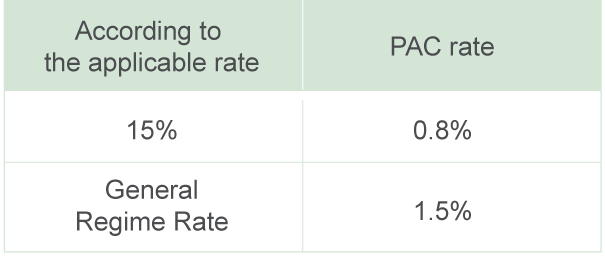
These companies may also deduct up to 10% of the amounts supported by payment vouchers issued by subjects under the NRUS; said percentage is calculated over the total amount including taxes.
They will also have the additional deduction of 25% for purchases from small producers, calculated over the value without taxes.
- The procedure and requirements to access the tax refund provided for in the Law are established, as well as the procedure to request the corresponding refund. Likewise, the IGV refund is regulated for those who re-apply for the exemption under Appendix I, regarding acquisitions made from the date of application; as well as the simplified restitution limit for customs duties.
New version of the PDT ISC Virtual Form No. 615 is approved
Superintendency Resolution No. 000022-2026/SUNAT, published on February 8, 2026, approves version 5.8 of the ISC PDT - Virtual Form No. 615, which must be used as of February 9, 2026, regardless of the period to which the declaration corresponds, even in the case of substituting or amending declarations.
NATIONAL CURRENT AFFAIRS
Condition of Subjects without Operational Capacity (SSCO) within the framework of a tax audit procedure
With Report No. 010-2026-SUNAT/7T0000, SUNAT rules on the implications of the SSCO list published while a tax audit is being carried out in parallel:
- If the SSCO (Subjects without Operational Capacity) list is published during a definitive or partial non-electronic audit (initiated before the SSCO resolution becomes final), the automatic rule of losing the IGV tax credit and the IR (Income Tax) cost/expense is not applicable. Those vouchers will be evaluated within the aforementioned audit.
- If a review is requested within 30 business days from the publication of the SSCO list (for vouchers issued up to that publication), SUNAT must open a partial audit. The automatic rule detailed in the previous paragraph does not apply either.
- If the review is not requested within 30 business days and there is no audit in progress, the automatic rule will indeed apply in a subsequent audit, whereby operations with the SSCO will not grant IGV tax credit or cost/expense for the IR.
JURISPRUDENCE
Acts declared null in the suspension of the tax statute of limitations (Judgment No. 04068-2023-PA/TC)
The Constitutional Court develops important criteria for a proper interpretation of Article 46 of the Tax Code, which establishes the suspension of the statute of limitations in tax matters during the processing of a tax contentious procedure.
Thus, based on the principles of reasonableness, legality, interdiction of arbitrariness, and legal certainty, the Constitutional Court concludes the following:
- Prescription is suspended only by valid acts: For the Court, the calculation of the prescription period can only be suspended during a tax contentious procedure linked to validly issued acts. Consequently, if these acts are declared null and void, the calculation of the prescription period should not be suspended during the processing of said procedure because those acts lack any legal effect. Allowing these null acts to suspend the prescription would mean granting them legal effects that violate the principle of legal certainty and the principle of reasonableness.
- Tax contentious procedures that culminate in null acts DO NOT suspend the prescription: During procedures linked to null acts, the calculation of the tax prescription period must continue. Otherwise, the Tax Administration would be allowed to benefit from its own errors. This would imply not only a violation of the principles of legality and predictability, but also a disincentive for taxpayers to exercise their right of defense.
- Before the amendment of the General Customs Law introduced by Legislative Decree No. 1433, there was a joint calculation of the prescription for the actions to determine, collect, and sanction: If the prescription of the collection action for a customs debt had occurred before the amendment, it is not appropriate to apply the changes introduced by Legislative Decree No. 1433, as this constitutes a retroactive application of the law, which contradicts Article 103 of the Constitution.
Support to prove the use of "recognized markets" in a case of Financial Derivative Instruments (FDI) (Cassation No. 18462-2025 LIMA)
The controversial issue in judicial proceedings focused on the accreditation of the use of "recognized markets" in determining the price of the FDI signed with a financial system entity (as a requirement for its qualification as "hedging").
The defense alleged that the price used for the FDI was determined by taking the prices of the applicable recognized markets as a reference, which was proven through banking documentation (a letter) issued by said entity. SUNAT and the Tax Tribunal questioned the "hedging" qualification, claiming that the support presented was allegedly insufficient.
The Supreme Court annulled the second-instance judicial sentence (Superior Court) upon detecting improper reasoning regarding the evidentiary valuation performed, emphasizing the need to explain the reasons for disregarding the letter issued by the banking entity as well as for the intended requirement to present additional evidence such as charts and the information considered for price setting.
Calculation of the prescription period to impute joint and several liability (RTF No. 0021-9-2026)
The Tax Tribunal establishes that the prescription period applicable to determine joint and several liability is the original period corresponding to the taxes or sanctions generated or attributable to the respective taxpayer; therefore, it is not appropriate for SUNAT to notify a Determination Resolution of Attribution of Joint and Several Liability to the responsible third party once said prescription period to determine the tax obligation or impose a sanction on the taxpayer has expired.