Public Law Alert - October 2026


Public Procurement Tribunal Approves Plenary Chamber Agreement: Inaccurate Information Results in Disqualification of the Bid Without the Need to Prove a Specific Advantage or Benefit
On October 26, 2026, Plenary Chamber Agreement No. 004-2026/TCP (hereinafter, the “AGREEMENT”), issued under Law No. 32069, the General Public Procurement Law (hereinafter, the “GENERAL LAW”), was published in the Official Gazette El Peruano.
Through this binding precedent, the Public Procurement Tribunal established that proving the existence of inaccurate information in a bid is sufficient to warrant its exclusion on appeal, without the need to determine whether such information resulted in a specific advantage or benefit. The AGREEMENT will enter into force on October 27, 2026.
Accordingly, the Tribunal harmonizes the criteria applicable to a discrepancy among its chambers regarding whether the mere presence of inaccurate information was sufficient to order the non-admission or disqualification of a bid, or the revocation of the award, or whether it was also necessary to determine whether such information resulted in a specific advantage or benefit. The decision was adopted by a majority of thirteen (13) votes to three (3).
The approved criterion is as follows:
“If, during the proceedings on an appeal, the Tribunal confirms that a bidder’s bid or the documents submitted by the bidder for the formalization of the contract contain inaccurate information, the Tribunal shall order the bid’s non-admission or disqualification, or the revocation of the award, as applicable, and order the initiation of the corresponding administrative sanctioning proceeding. In making its decision in the appeal proceedings, it is not necessary to determine whether such information resulted in a specific advantage or benefit; this element must be examined, together with the other elements of the infringement, in the administrative sanctioning proceeding”.
The AGREEMENT is based primarily on the principles of the presumption of truthfulness and integrity, as well as on the Integrity Pact submitted by bidders as part of their bids. Based on these principles, the Tribunal considers that, once the inaccuracy has been established, the presumption of truthfulness is rebutted and the bid can no longer remain valid in the procurement procedure, “even if, disregarding such information, the bid could otherwise meet the requirements set out in the bidding documents”.
What changes under the AGREEMENT?
First, for purposes of appeal proceedings, the AGREEMENT rejects the position that the definition of inaccurate information set out in subparagraph (l) of paragraph 87.1 of Article 87 of the GENERAL LAW should apply, as this definition requires the information to necessarily and directly affect the obtaining of a specific advantage or benefit. Under this position, a bid should not be excluded where, disregarding the challenged information or even the document containing it, the bid meets the requirements set out in the bidding documents based on the remaining information or documentation.
Second, the AGREEMENT addresses the legislative change. Under the Consolidated Text of former Law No. 30225, the State Procurement Law, the infringement required the information to relate to a requirement, evaluation factor, or other condition that represented an advantage or benefit. The GENERAL LAW requires the information to necessarily and directly affect the obtaining of a specific advantage or benefit.
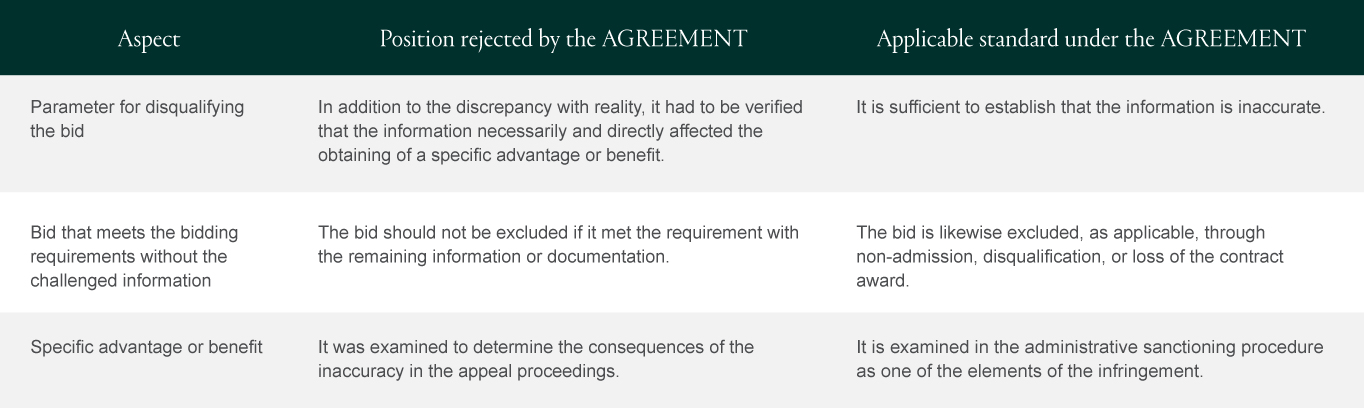
In practical terms, the new precedent reinforces the need for bidders to verify in advance the accuracy of all information included in their bids and in the documents submitted for the formalization of the contract. Inaccurate information may result in the non-admission or disqualification of the bid, or the revocation of the award, as applicable, even where the information in question was not necessary to meet the requirements set out in the bidding documents, without prejudice to the fact that any administrative liability must subsequently be determined in the relevant administrative sanctioning proceeding.