Maritime Alert - October 2026


Peru incorporates Amendment 42-24 to the IMDG Code into its national maritime legal framework
Directoral Resolution No. 683-2026-MGP/DICAPI
OVERVIEW
The Peruvian State, through Directoral Resolution No. 683-2026-MGP/DICAPI, published on October 15, 2026, incorporated Amendment 42-24 to the International Maritime Dangerous Goods Code (IMDG Code) into the national legal framework. The amendment was adopted by the Maritime Safety Committee of the International Maritime Organization through Resolution MSC.556(108).
The update introduces significant amendments to the classification, identification, packing and packaging, marking, labeling, documentation, stowage, and segregation of dangerous goods. Compliance is particularly important for exporters, importers, shippers, and maritime carriers, both from a regulatory compliance perspective and when determining liability for losses, damage, fires, or other incidents involving such goods.
In maritime transport subject to the Hamburg Rules, the IMDG Code also serves as a relevant technical standard for assessing compliance with the duties of the shipper and the carrier, particularly with respect to the identification, provision of information, declaration, handling, stowage, and safe carriage of dangerous goods.
THE REGULATION
The International Maritime Dangerous Goods Code (IMDG Code) establishes the provisions applicable to the maritime transport of dangerous goods in packaged form. Compliance with these provisions is mandatory pursuant to Chapter VII of the International Convention for the Safety of Life at Sea, 1974 (SOLAS 1974), within the scope of its application.
Through Directoral Resolution No. 683-2026-MGP/DICAPI, the National Maritime Authority incorporated Amendment 42-24 to the IMDG Code into the national legal framework. It also repealed Directoral Resolution No. 292-2020-MGP/DGCG, which had incorporated Amendment 39-18. The resolution entered into force on October 16, 2026, the day following its publication in the Official Gazette El Peruano
KEY AMENDMENTS
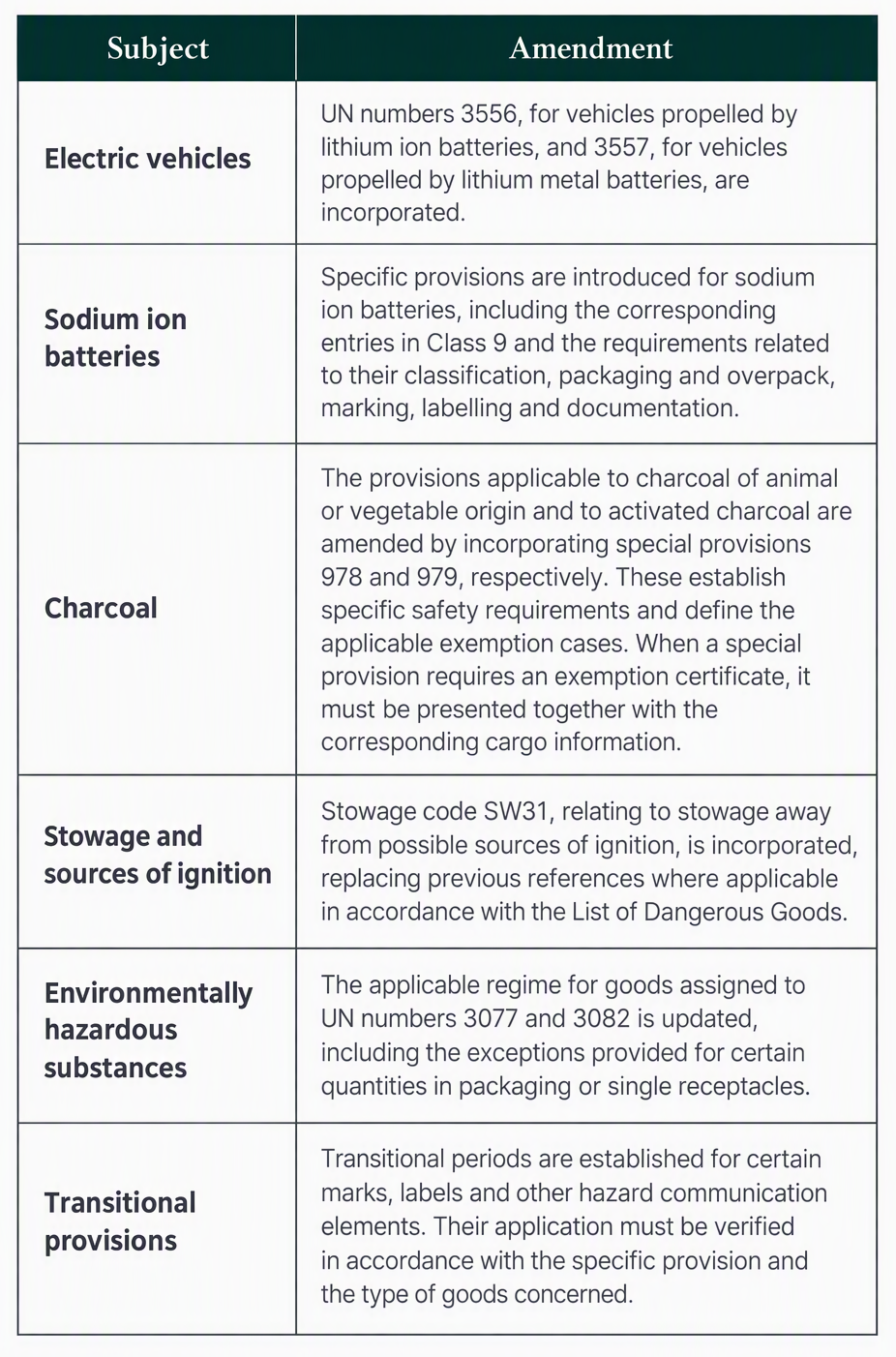
IMPACT ON MARITIME TRANSPORT: HAMBURG RULES
- Since April 1, 2022, the United Nations Convention on the Carriage of Goods by Sea, 1978 (Hamburg Rules) has been in force in Peru, following Peru’s accession thereto through Supreme Decree No. 006-2021-RE. From the perspective of the contract of carriage by sea, the requirements of the IMDG Code constitute a particularly relevant technical benchmark for determining the content and scope of the shipper’s and carrier’s duties with respect to dangerous goods, particularly when interpreting and applying Articles 5 and 13 of the Hamburg.
- Marking and labeling (Article 13.1). The shipper must properly mark or label dangerous goods. Compliance with the IMDG Code in force will be a key technical factor in assessing whether this obligation has been fulfilled, including with respect to new entries and applicable UN numbers.
- Duty to provide information (Article 13.2). When the shipper delivers dangerous goods to the carrier or the actual carrier, the shipper must inform them of the dangerous nature of the goods and, where necessary, of the precautions to be taken. If the shipper fails to comply with this duty and the carrier is otherwise unaware of the dangerous nature of the goods, the shipper may be held liable for losses resulting from their shipment. In addition, the goods may be unloaded, destroyed, or rendered innocuous, as the circumstances may require, without any obligation to pay compensation.
- Carrier’s knowledge and actual danger (Articles 13.3 and 13.4). Where the carrier or any person who has taken charge of the goods during carriage is aware of their dangerous nature, the carrier may not invoke the powers provided for in Article 13.2, subject to the terms of Article 13.3. However, if the goods constitute an actual danger to human life or property, they may be unloaded, destroyed, or rendered innocuous, as the circumstances may require, without prejudice to the exceptions concerning general average and the carrier’s liability set out in Article 13.4.
- Basis of the carrier’s liability and burden of proof (Article 5.1). Failure to comply with the applicable requirements for the handling, stowage, or segregation of dangerous goods may be relevant in assessing whether the carrier, its servants, or its agents took all measures that could reasonably be required to avoid the occurrence giving rise to the loss, damage, or delay, and its consequences.
- Fire (Article 5.4). In cases of loss, damage, or delay caused by fire, compliance or non-compliance with the technical requirements of the IMDG Code may constitute particularly relevant evidence in determining whether fault or negligence occurred and establishing the corresponding causal link, particularly in incidents involving electric vehicles or batteries. A breach of the IMDG Code does not, in itself, automatically give rise to civil liability. However, it may constitute an important technical and evidentiary factor in determining the applicable standard of conduct, identifying contractual or regulatory breaches, and assessing the causal connection with the incident.